01
Deployable Structures
Fold-kinematic aluminum-frame habitats engineered for one-pallet transport and stop-watched two-person deployment. Composite decks and assist-actuated panel pairs.
Expeditionary Energy Systems
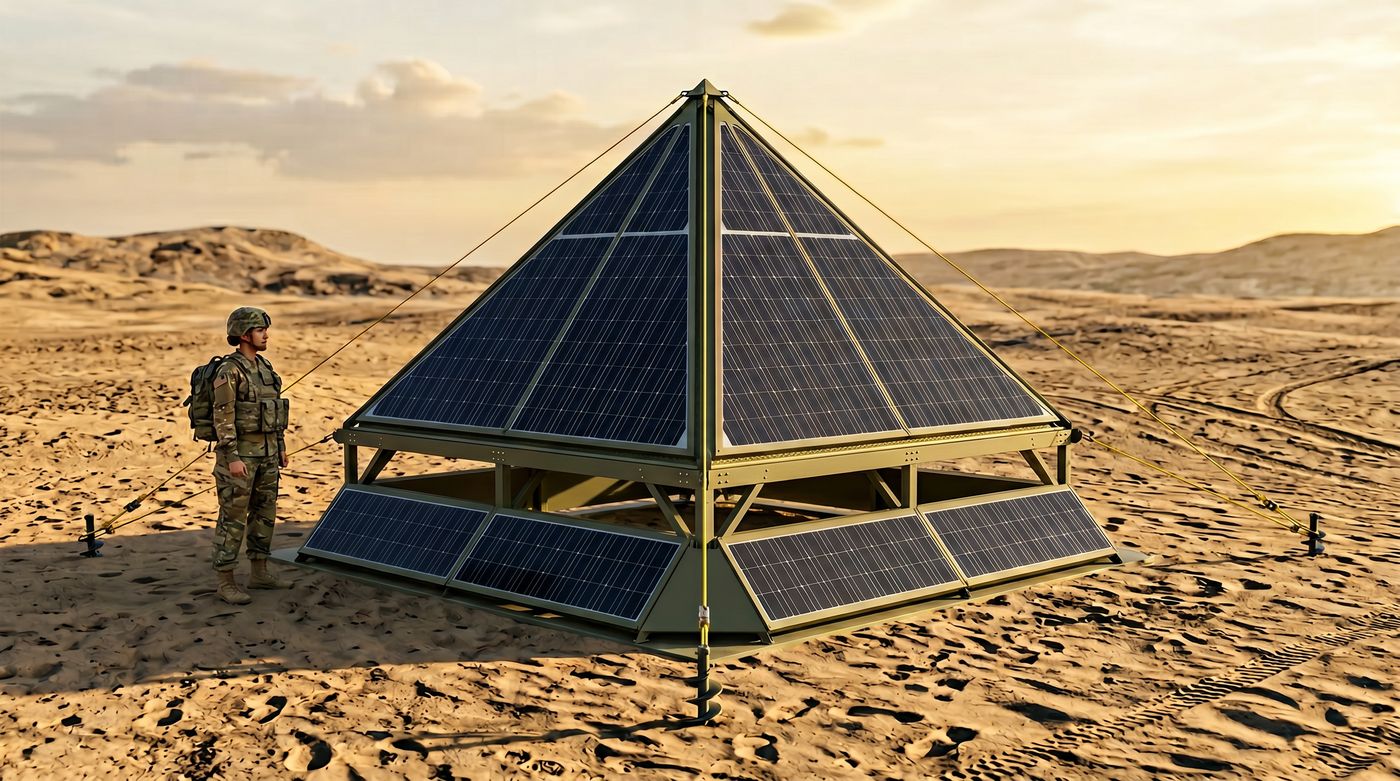
Harbison R&D develops deployable, solar-equipped squad habitats with integrated Faraday-shielded power cores — engineered for the U.S. Army’s expeditionary, multi-domain, and humanitarian mission set.
Capabilities
Concept-to-prototype engineering for deployable structures, integrated photovoltaic/storage power systems, and EMP-hardened command-and-control enclosures. Every system designed to a single 463L pallet, two-soldier deployment, and a sub-five-minute standup.
Fold-kinematic aluminum-frame habitats engineered for one-pallet transport and stop-watched two-person deployment. Composite decks and assist-actuated panel pairs.
Multi-face flexible photovoltaic arrays, hybrid load-bearing / power-carrying tensioning, mil-spec battery banks, and split-phase inverter stacks delivering multi-kilowatt expeditionary power.
Dual-layer woven shielded enclosures with filtered penetrations, targeting MIL-STD-188-125 envelope compliance for sensitive command-and-control electronics.
Same platform serves DoD expeditionary, DSCA/FEMA disaster response, and commercial remote operations (mining, research stations). One design, three markets, minimal variant cost.
Current R&D Program
The Bipyramid Mk2 is a rapidly deployable solar shelter with an integrated Faraday-shielded power core and an extended photovoltaic array. A single standard military pallet transports a complete self-powered habitat — multi-kilowatt PV harvest, on-board lithium storage, a split-phase inverter, and a shielded enclosure capable of hosting sensitive command-and-control electronics under GPS-denied conditions.
Two soldiers can deploy the structure in minutes without specialized tools. The platform replaces the combined footprint of a soft-wall tent, an external gen-set, a fuel bladder, and a separate shielded C2 module.
IP & Filing Status
Filed via USPTO Patent Center, April 20, 2026.
Geometry · folding kinematics · integrated PV skin · Faraday power core · hybrid power-carrying guy cables · extended-array embodiment.
Variant · Mk1-L
A scaled-down, suitcase-deployable embodiment of the Mk1 power core — re-qualified for lunar surface use. Half-buried in regolith to harvest the thermal gradient between the +120 °C daytime surface and the −20 °C sub-surface, producing continuous power through the 354-hour lunar night without an RTG.
0.85 × 0.55 × 0.25 m closed · 28 kg dry.
1.4 m across · 1.2 m tall · upper half exposed, lower half buried to the equator.
720 W photovoltaic · ~120 W thermoelectric during lunar day.
Regolith thermal-gradient TEG + 1.2 kWh LiFePO4 buffer. Survives full 708 h cycle.
Single-EVA astronaut · ~30 min rover-assisted. 0.30 m³ excavation.
Distributed surface power at equatorial or polar sites without RTG or fission reactor.
IP provenance · Embodiment of U.S. Provisional Patent Application 64/044,076 (parent Mk1). Stand-alone claims for the half-buried, thermally-harvested, extraplanetary-surface configuration are included in the forthcoming non-provisional filing.
TRL 2 · Analytical concept · Document HRD-TD-MK1L-001, v1.0, April 2026
Research Notes
In parallel to the core hardware program, Harbison R&D publishes short, timestamped hypothesis briefs — working notes at the edge of neuroscience, computational psychiatry, and systems biology. These are perspective papers, not clinical guidance.
A computational and phenomenological parallel between autism and the psychedelic state.
Proposes that autism may represent a chronically REBUS-like predictive coding state — attenuated priors and over-weighted prediction errors — potentially rooted in developmental dysregulation of endogenous DMT metabolism and 5-HT2A receptor activity. Synthesizes three active research threads: endogenous DMT function, predictive-coding models of autism, and the REBUS model of psychedelic action.
Read the brief →Research briefs reflect the views of the author and are published for discussion among researchers. They are not medical advice, not peer-reviewed, and independent of the Bipyramid hardware program.
Publications
In parallel to the hardware and research-brief programs, Harbison R&D occasionally publishes open technical disclosures — timestamped, peer-readable engineering concepts placed in the public domain under CC‑BY 4.0. These are not patent filings. They establish prior art and invite capable parties to build on, critique, or refute the work.
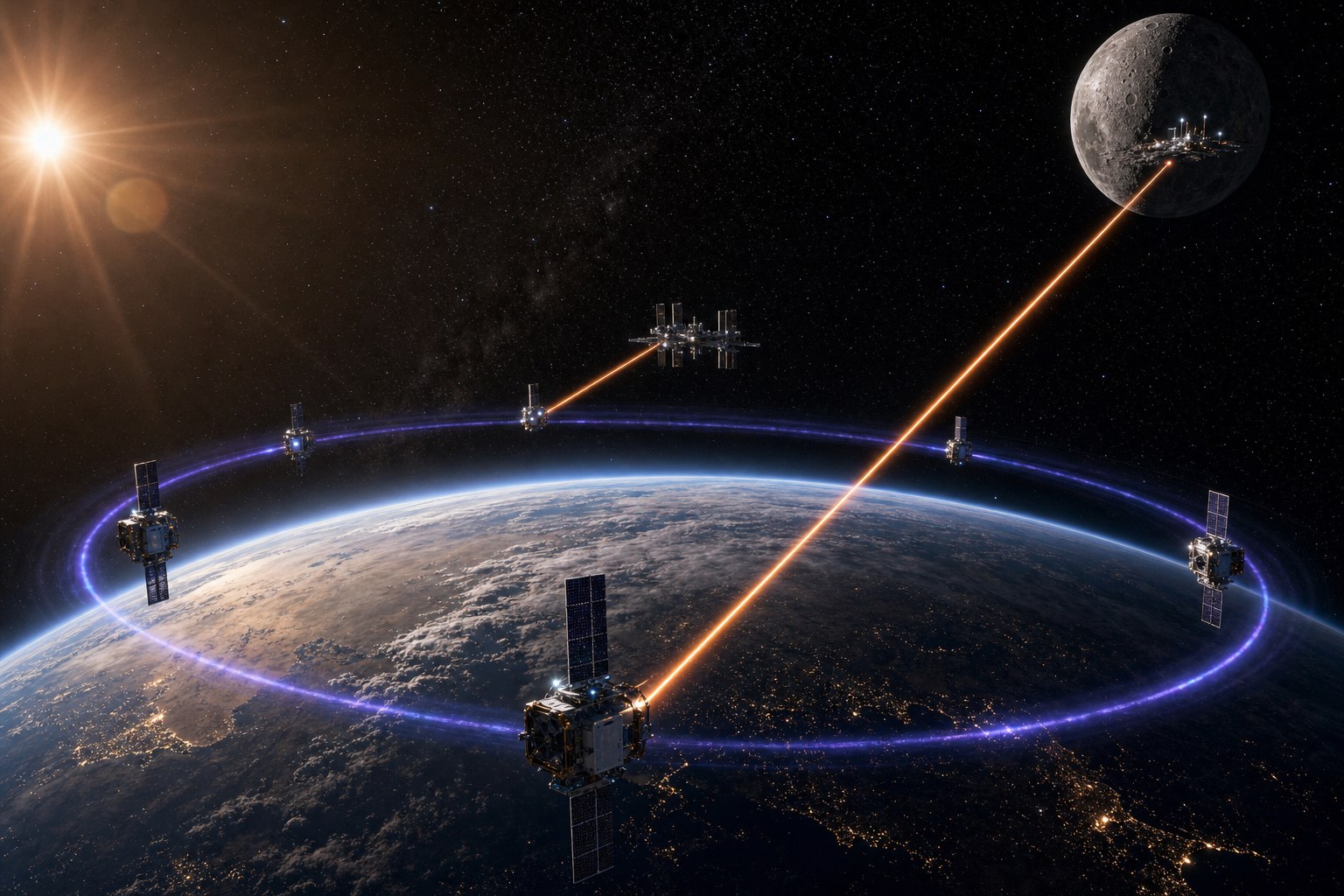
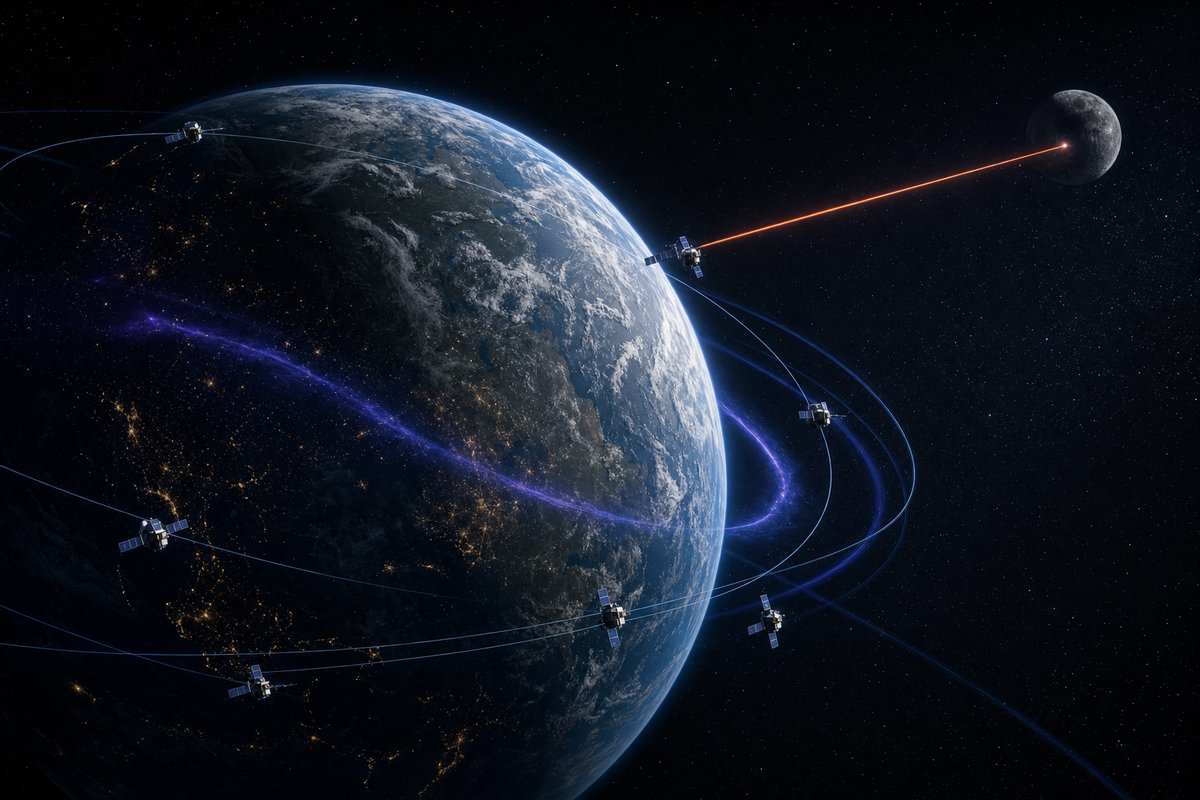
A defensive disclosure describing a kinetic energy storage architecture for the emerging orbital power economy.
A method is described for storing electrical energy in space using a charged particle beam circulating in Earth’s geomagnetic field, with energy injection and extraction performed by oscillating ion cluster kickers (OICKs) mounted on a constellation of satellites operating within the inner Van Allen belt (approximately 2,000–3,000 km altitude). The system functions as a kinetic battery for orbital power infrastructure, complementing existing or proposed space-based solar power architectures. Unlike chemical batteries, the storage medium does not degrade with cycling. The geomagnetic field provides the confining structure without mass cost. The disclosure covers the architecture, the underlying physics, energy balance estimates, and integration with current orbital power proposals.

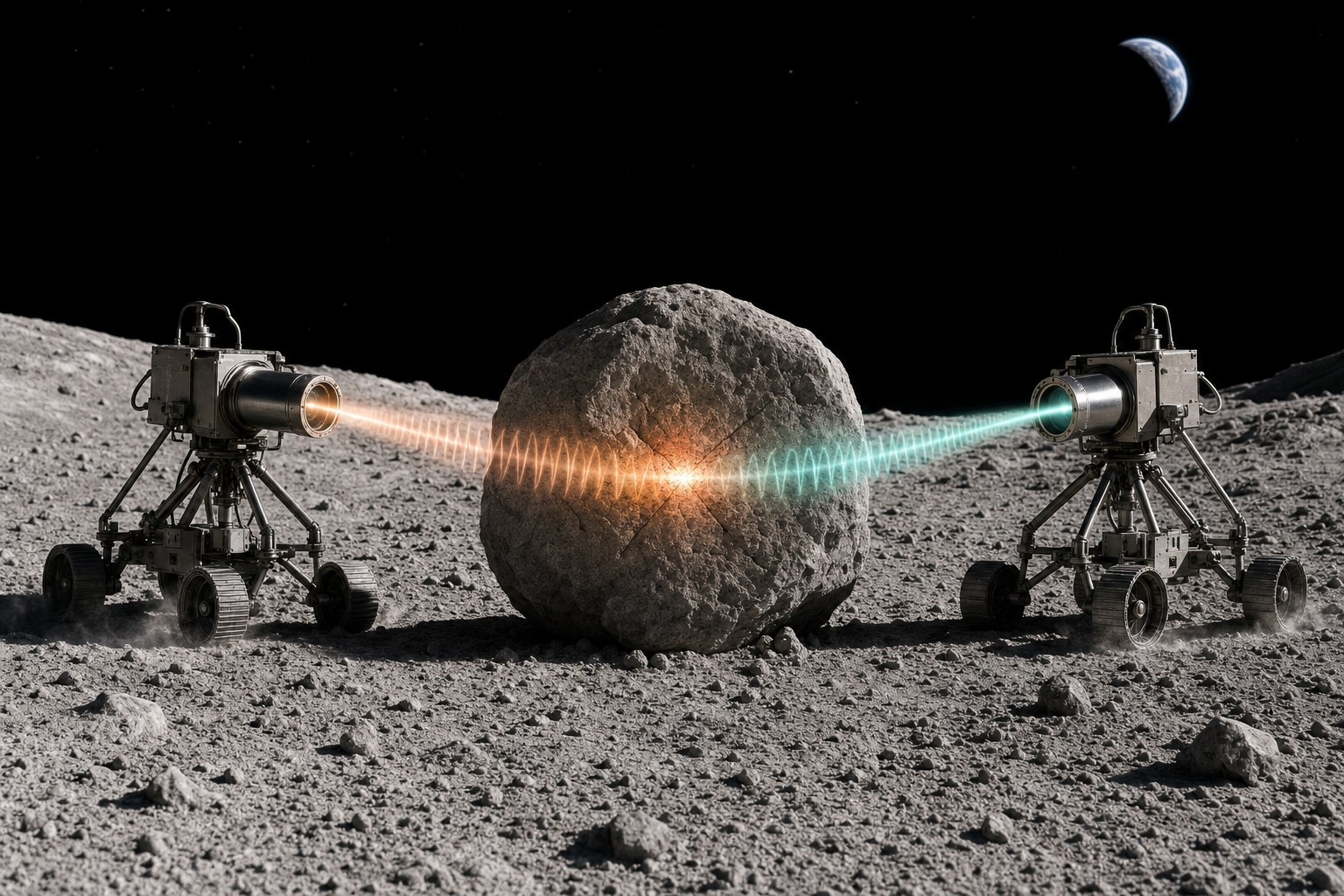
A defensive disclosure on a bilateral millimeter-wave drilling architecture for the Moon, Mars, asteroids, and terrestrial deep-rock applications.
A method is described for pre-fracturing rock using two or more counter-propagating millimeter-wave or microwave beams aimed at the same target volume from opposite sides. Standing-wave interference and overlapping absorption produce interior thermal-stress concentrations that initiate cracks at much lower bulk energy density than vaporization-based drilling, while the symmetric geometry largely cancels the net momentum imparted to the rock face. The architecture is intended primarily for low-gravity surface drilling on the Moon, Mars, and asteroids — where reaction-force budgets are extremely limited — and as a pre-conditioning step for terrestrial mechanical drills. The disclosure covers the baseline two-beam geometry at 100 GHz, lower-frequency variants (10–30 GHz and below) that trade hotspot resolution for deeper penetration, and multi-beam variants (four- and six-beam symmetric arrangements). A combined two-stage embodiment uses lower-frequency beams for bulk softening and high-frequency beams for crack finishing. Companion disclosure to HRD‑PUB‑2026‑01 (OICK).
Open disclosures are published independent of the Bipyramid hardware program and the Harbison R&D research-brief series. The author makes no claim of patent protection on disclosed material and explicitly intends each disclosure to establish prior art so that any party may freely build on the concepts.
Contact
For licensing inquiries, government program interest, or partnership conversations, reach out directly or use the form. All sensitive technical disclosures require a mutual NDA — template available on request.